GREENGAGE
ggrebalance: Part 3. Executing a rebalance operation
07.08.2026
This article covers the execution side of the ggrebalance utility: the physical movement of primary and mirror segments between hosts in a Greengage DB cluster, the design of the rebalance state machine, operation status tracking, failure handling and reentrancy, rollbacks, practical operational recommendations, and a final comparison with alternative tools.

Alexander Kondakov
C Developer

Contents
- 3.1 Challenges of moving segments
- 3.2 Types of moves performed
- 3.3 Rebalance state machine
- 3.4 Tracking operation status
- 3.5 Reentrancy. Possible failures and how they’re handled
- 3.6 Rolling back a rebalance
- 3.7 Usage scenario and useful options
- 3.8 Availability and operational recommendations
- Conclusion
The previous article covered the planning mechanism in detail: how the ggrebalance planner builds a list of segment moves to distribute them evenly across hosts, and which scenarios it handles — shrinking, adding hosts, and decommissioning hosts.
Part 3 is about how that plan is actually executed: how segments are physically moved between machines in a running cluster.
3.1 Challenges of moving segments
Moving a segment with data is a fundamentally hard problem.
A Greengage segment is a full-fledged PostgreSQL instance. It serves its share of every distributed query, takes part in a two-phase commit, streams WAL continuously, and interacts with the FTS (Fault Tolerance Service) mechanism.
Its address, port, and data path are stored in gp_segment_configuration, the table the dispatcher consults when routing every query.
Any mismatch between the catalog and the segment’s actual state immediately breaks the cluster.
Moving a segment can disrupt the cluster just as easily, so without careful preparation a move risks data loss, consistency violations, or query errors.
In theory, you could take the offline route: stop the whole cluster, copy PGDATA to the new hosts, update the gp_segment_configuration catalog in coordinator-only mode, and restart everything.
It’s straightforward, but error-prone, and the downtime it causes is too long for production.
ggrebalance instead moves segments online, relying on Greengage’s own capabilities: streaming replication, FTS probing, and role switching between primary and mirror.
Greengage itself does not provide a single tool for arbitrarily moving segments between hosts.
ggrebalance combines two standard tools from the ecosystem, each covering half the job:
-
gpmovemirrors— physical data relocation. The utility moves mirror segments. It works in three phases. First, it creates a new data directory on the target host viapg_basebackup, physically copying data from the primary segment. Then it waits for the new instance to finish synchronizing with the primary. Finally, it updates the corresponding entry in thegp_segment_configurationsystem catalog. None of this touches the primary segments; the operation is transparent to users running queries. The key limitation ofgpmovemirrorsis that it works exclusively with mirrors. Moving primary segments is a different story, and it needs its own mechanism. -
gprecoverseg -r— role switching. The utility restores the "preferred" role assignment, switching segments to the roles recorded in thepreferred_rolefield ofgp_segment_configuration. Here’s how it works: the utility finds pairs whose current role diverges frompreferred_role, then stops the primary segments infastmode. FTS then automatically detects the failure and promotes the mirror to primary. A regulargprecoversegrun restores synchronization after that — the former primary becomes a mirror and starts replicating from the newly promoted segment. Role switching is one stage of moving a primary segment (the full process is covered in detail in the next section).
Move operations inevitably affect cluster availability and reliability, so this must be considered during planning.
During a mirror move (gpmovemirrors), the primary segment keeps serving queries without interruption.
The mirror, however, is temporarily unavailable during copying and the subsequent synchronization.
This temporarily reduces fault tolerance: if the primary fails during this window, its data becomes unrecoverable.
Role switching works differently. The primary segment is stopped forcibly, and any transactions it was processing at that moment are aborted.
FTS promotes the mirror to primary.
That takes some time, and that time counts as downtime — though far shorter than the offline approach.
ggrebalance provides the --replay-lag option, forwarded to gprecoverseg, which sets the maximum mirror lag allowed before triggering a switchover.
It’s a way to trade operation speed against consistency guarantees.
Because ggrebalance is reentrant, the role-switching stage can be postponed to a scheduled maintenance window, leaving the cluster in an intermediate but fully functional configuration.
3.2 Types of moves performed
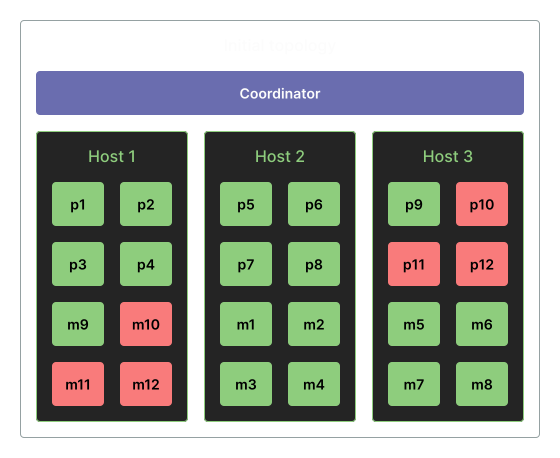
Consider the process of balancing a cluster after a shrink (Figure 1).
Figure 1. Shrinking three segments
The planner component described in the second article of the series builds a move plan that, once executed, results in an even distribution of segments across hosts. The plan looks like this:
20260412:20:09:41:014374 ggrebalance:cdw:gpadmin-[INFO]:-Final plan:
---------------------------BALANCE MOVES---------------------------
Total moves planned: 4

  [1] Move Segment(content=3, dbid=5, role=p) [16.25 GB]
      From: sdw1:7005:/home/gpadmin/.data/primary/gpseg3
      To:   sdw3:7005:/home/gpadmin/.data/primary/gpseg3

  [2] Move Segment(content=3, dbid=17, role=m) [16.19 GB]
      From: sdw2:7055:/home/gpadmin/.data/mirror/gpseg3
      To:   sdw1:7055:/home/gpadmin/.data/mirror/gpseg3

  [3] Move Segment(content=7, dbid=9, role=p) [16.25 GB]
      From: sdw2:7009:/home/gpadmin/.data/primary/gpseg7
      To:   sdw3:7009:/home/gpadmin/.data/primary/gpseg7

  [4] Move Segment(content=7, dbid=21, role=m) [16.19 GB]
      From: sdw3:7059:/home/gpadmin/.data/mirror/gpseg7
      To:   sdw1:7059:/home/gpadmin/.data/mirror/gpseg7

=====================================================================
The printed plan is logical: it shows which segments need to move where so the cluster becomes balanced.
For moving a mirror, this representation is more than enough, since a mirror can be relocated to another host in a single step with one call to gpmovemirrors.
Primary segments are a bit trickier — Greengage doesn’t support online migration of a primary segment without a service interruption.
So ggrebalance moves a primary segment through a three-step scheme: promote the mirror to primary, move the former primary (now a mirror) to the target host, then revert to original roles.
ggrebalance implements this sequence as follows (Figure 2):
- Step 1. Switchover primary → mirror
-
For
gprecoverseg -rto trigger a role switch, the segments'roleandpreferred_roleattributes ingp_segment_configurationmust first disagree. To create that mismatch,ggrebalanceatomically updates two rows ofgp_segment_configurationduring the switchover: it flipspreferred_rolefromptomfor the former primary, and frommtopfor the mirror. Thengprecoverseg -ris called, which promotes to primary every mirror whose catalog attributes disagree. - Step 2. Moving the mirror
-
The old primary, now running as a mirror, is relocated to the target host via
gpmovemirrors. The cluster operates normally throughout: the new primary serves queries, while the relocated mirror synchronizes with it from its new location. - Step 3. Switchover mirror → primary
-
Another
gprecoverseg -rcall, preceded by another manual catalog update, restores the preferred roles: the segment on the target host becomes the primary, and the former primary (on the original host) becomes the mirror. Once this step finishes, the primary segment has effectively "moved"; its mirror sits exactly where it was before.
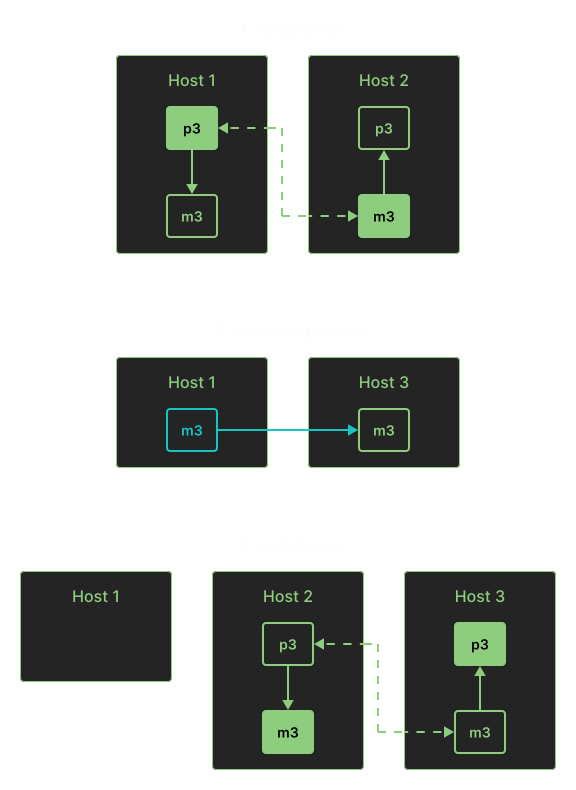
Figure 2. Moving a primary segment
Because pg_basebackup runs for a fairly long time during a gpmovemirrors call, executing plan steps strictly sequentially is impractical in production.
So ggrebalance parallelizes move execution instead.
The executor component converts the logical plan produced by the planner into a physical plan.
At the execution level, the whole plan is divided into atomic steps of three kinds, implemented as subclasses of RebalanceStep and described in Table 1.
| Step type | Python class | Tool | What it does |
|---|---|---|---|
Move mirror |
RebalanceStepMoveMirror |
gpmovemirrors |
Physically relocates mirror data |
Switch to mirror |
RebalanceStepSwitchoverToMirror |
gprecoverseg -r |
Primary → mirror |
Switch to primary |
RebalanceStepSwitchoverToPrimary |
gprecoverseg -r |
Mirror → primary |
Steps of the same type that can run in parallel are grouped into batches.
For example, when moving several primary segments, the implementation doesn’t interleave switchover and move steps (switchover1 → move1 → switchover_back1 → switchover2 → move2 → …); instead, it groups steps of the same type together.
That way, gprecoverseg runs once for a whole group of switchovers instead of once per segment.
Operations within a batch run in parallel, and batch size can be controlled with the --parallel option.
3.3 Rebalance state machine
Like the shrink operation, cluster balancing is implemented on top of a state machine.
Explicit states and transitions give this design a few real advantages: the current stage is stored in persistent storage, execution is reproducible after a failure, and each stage’s logic stays cleanly separated.
What makes RebalanceSM reentrant is that each state is responsible for exactly one action, and immediately persists the fact that it was entered.
The state diagrams for the rebalance operation and its components are shown in Figures 3 and 4.
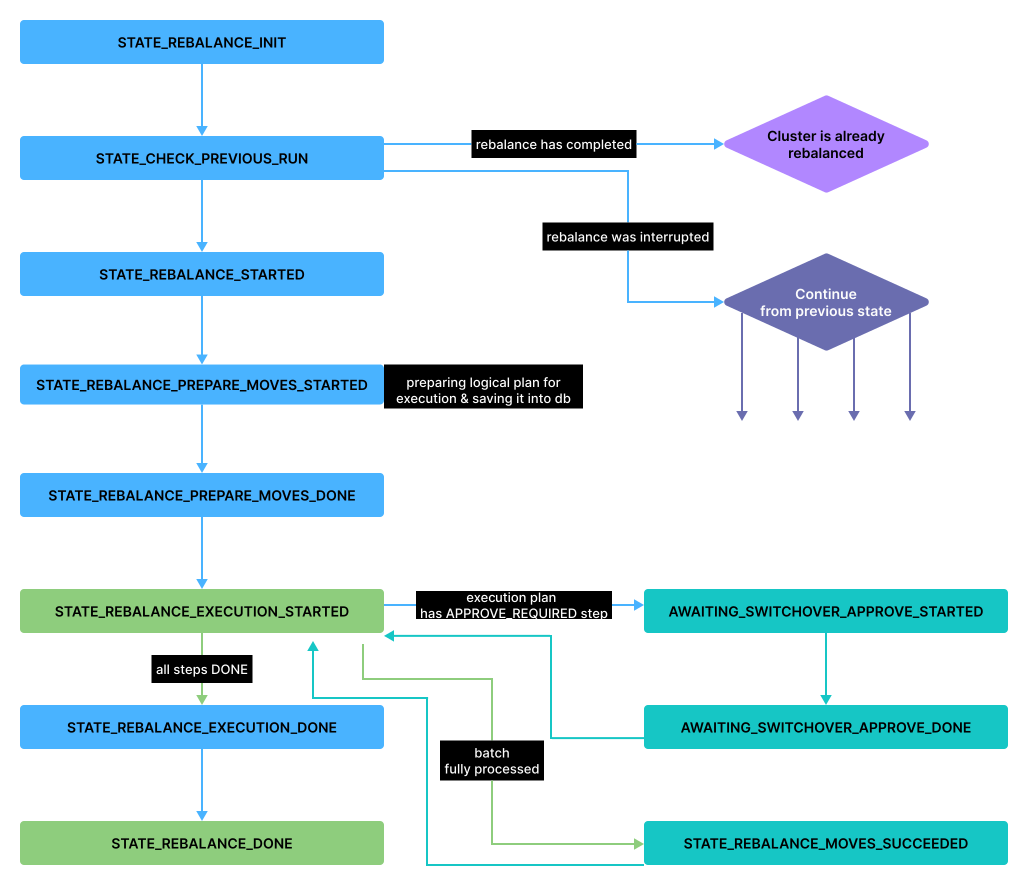
Figure 3. Rebalance operation state machine
- STATE_CHECK_PREVIOUS_RUN
-
Entry point on every
RebalanceSMrun. It reads the last saved state from theggrebalanceservice schema (more on status tracking in the next section) and determines whether this run is new or a continuation of an interrupted operation. - STATE_REBALANCE_PREPARE_MOVES_STARTED
-
One-time initialization: the plan is transformed into concrete execution steps, each is assigned a sequence number, and all steps are saved to the schema.
- STATE_REBALANCE_EXECUTION_STARTED
-
The main control loop re-enters after every executed batch. All the real work happens here: it checks whether every step is complete, handles steps left in
ERRORstatus from interrupted runs, forms the next batch, and executes it by callinggpmovemirrorsorgprecoverseg -r, depending on what kind of steps the batch contains. - STATE_REBALANCE_EXECUTION_AWAITING_SWITCHOVER_APPROVE_STARTED
-
An interactive checkpoint. By default,
ggrebalanceexplicitly asks the user to confirm before every batch of switchovers. That’s because role switching causes downtime — both the primary and the mirror are stopped at that moment. Manual confirmation of every such stage can be skipped by passing the-y/--approve-swap-rolesor--non-interactive-modeoption, which auto-approves role switches.
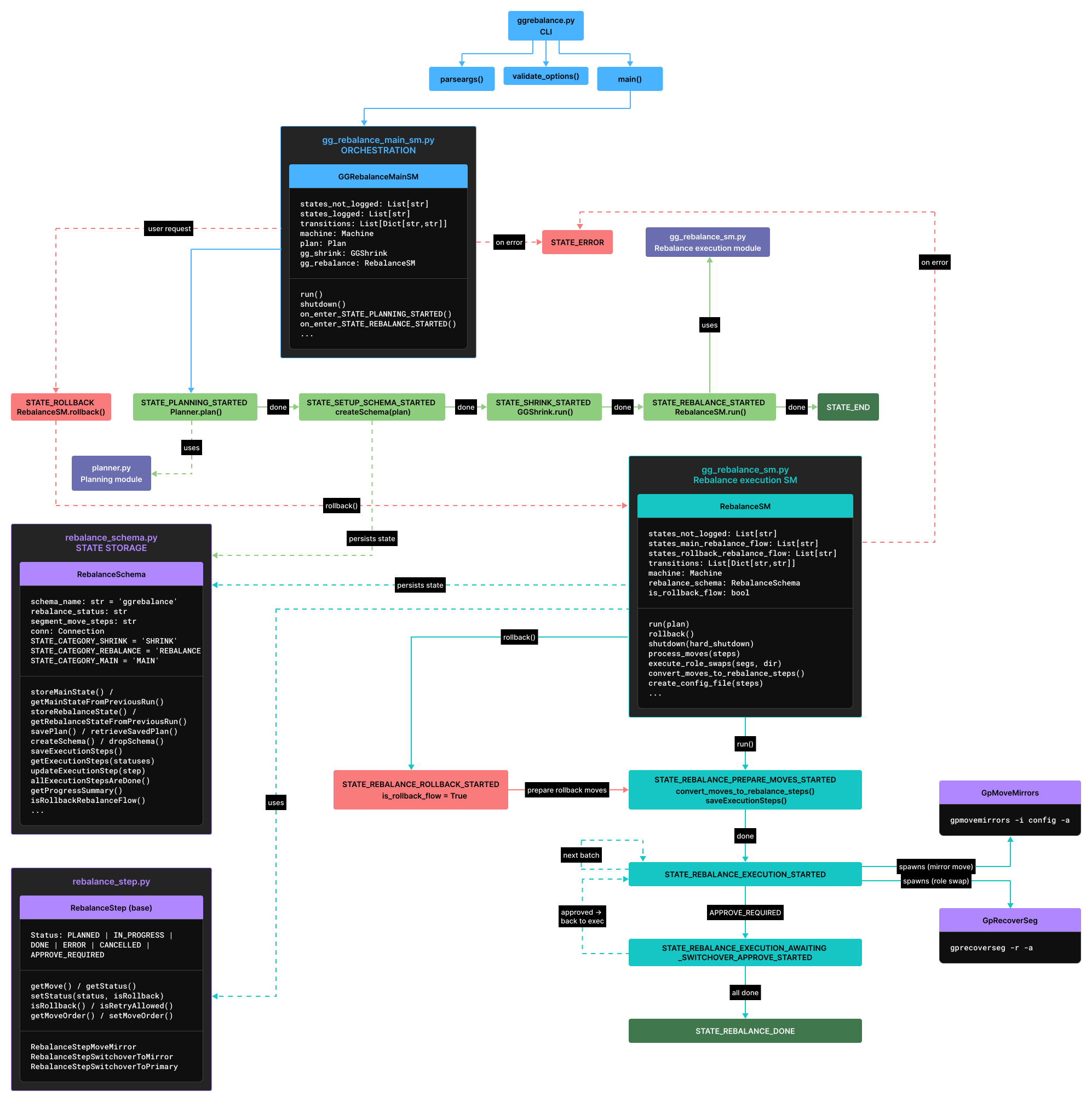
Figure 4. Rebalance operation implementation
A rollback mechanism for moves is also provided.
Rollback execution mirrors the forward rebalance flow, with only a few implementation and state-tracking nuances.
The rollback flow deliberately converges on STATE_REBALANCE_EXECUTION_STARTED, which eliminates execution logic duplication.
The rollback scenario is covered in more detail in the following sections.
3.4 Tracking operation status
As covered in the previous articles, every stage of what ggrebalance does — whether a shrink step or a cluster-balancing step — has a corresponding status, which Greengage stores in the ggrebalance service schema of the postgres database (Figure 5).
The schema holds the saved plan (for recovery after an interruption), the current state of the main state machine and the shrink and rebalance state machines, and tables with detailed information about every stage of the work.
Storing statuses directly in the DBMS was a deliberate choice, made to keep the utility’s work traceable and avoid losing information about completed operations.
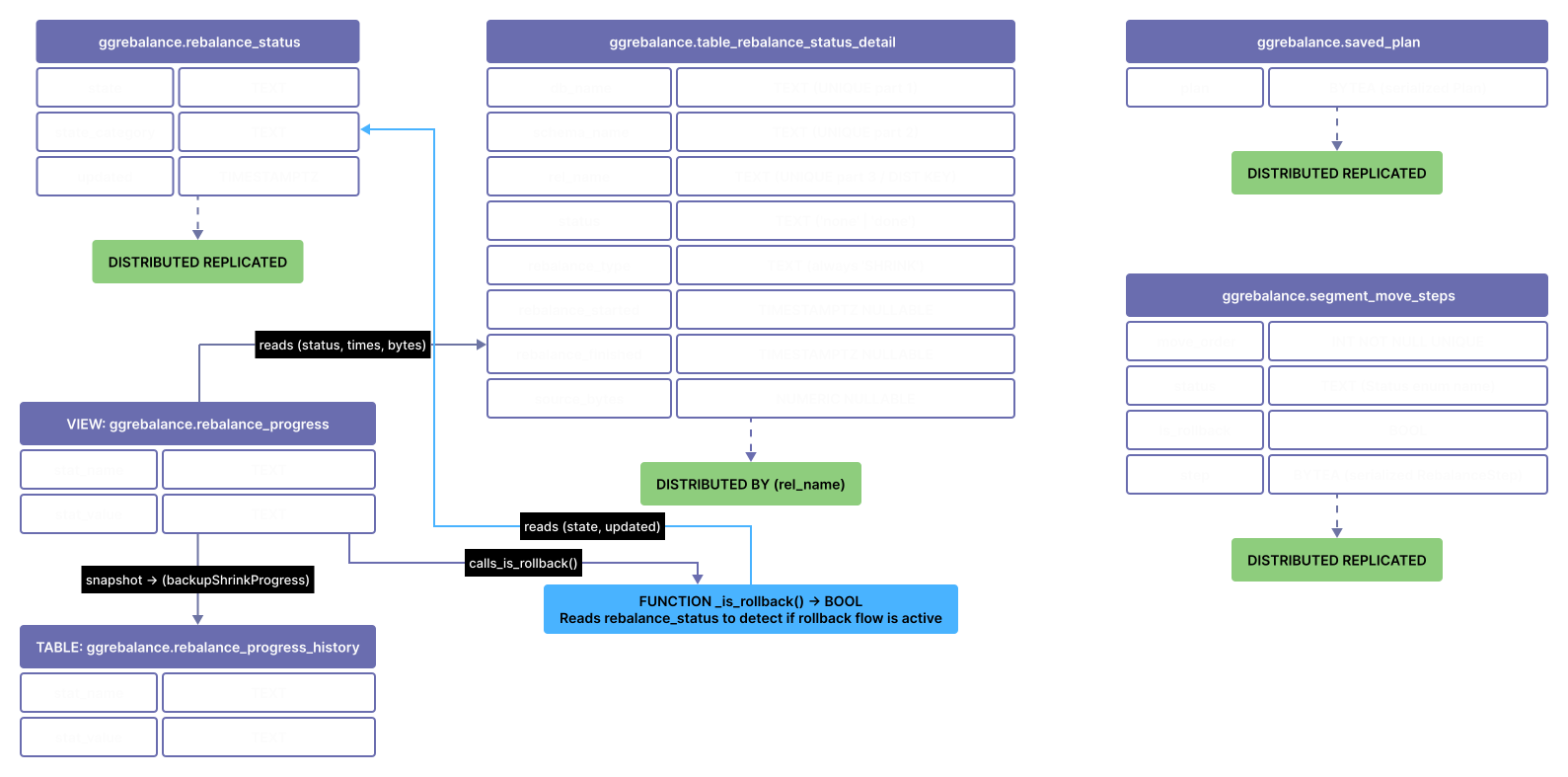
Figure 5. The ggrebalance service schema
For the balancing process, the ggrebalance.segment_move_steps table stores one of the following statuses for each planned move.
| Status | Meaning |
|---|---|
PLANNED |
Planned, ready to run |
APPROVE_REQUIRED |
Waiting for operator approval |
IN_PROGRESS |
Currently running |
DONE |
Completed successfully |
ERROR |
Failed with an error |
CANCELLED |
Cancelled because another step failed |
Switchover steps are deliberately created with APPROVE_REQUIRED status, as mentioned earlier — role switching briefly affects cluster behavior, and the operator has to consciously confirm readiness for it.
ggrebalance also logs extensively, the same way other cluster commands do.
Both standard output and the log file in the gpAdminLogs directory contain detailed information about the progress of ggrebalance.
Log verbosity can be controlled with two options: --verbose for detailed debug output on the Python utilities' work at each step, and --quiet to suppress normal logging.
3.5 Reentrancy. Possible failures and how they’re handled
Any long-running operation in a distributed system must assume it will be interrupted — by a network outage, a coordinator failure, or the maintenance window expiring.
ggrebalance was designed around this assumption — every run of the utility restores its context from the service schema and resumes work from where the previous run stopped.
On every run, STATE_CHECK_PREVIOUS_RUN reads the last saved state from the schema and determines the next state to transition into so the interrupted process can resume.
The mapping logic is as follows:
-
If there’s no saved state (
STATE_NOT_DEFINED), this is a fresh run, and the machine transitions toSTATE_REBALANCE_STARTED. -
If a final state is recorded, the cluster is already balanced, and there’s nothing to do.
-
STATE_REBALANCE_EXECUTION_STARTED,STATE_REBALANCE_MOVES_SUCCEEDED, andSTATE_REBALANCE_EXECUTION_AWAITING_SWITCHOVER_APPROVE_DONEall resolve toSTATE_REBALANCE_EXECUTION_STARTED, because that state knows how to "heal" itself on entry: it first analyzes and fixes steps inERRORstatus, and only then continues execution. -
Rollback states transition to the next state within the same flow.
-
All other states transition to the next state in the main flow (Figure 3).
For RebalanceStepMoveMirror steps, ggrebalance performs a detailed analysis of every failed step on restart, based on the cluster’s actual state:
-
Catalog check.
It queries
gp_segment_configurationfor the givendbid. If the segment’shostnamealready matches the target, the catalog was updated before the failure. -
Configuration file check.
If the catalog was updated,
GpConfigHelperreads postgresql.conf on the target host to check theportparameter. That shows how fargpmovemirrorshad gotten before the failure. -
Waiting for the segment to start.
If the port was also updated, a polling loop checks the segment’s state. If the segment has started and entered synchronized mode, the step is marked
DONE— no further action is needed. -
Interactively extending the wait.
If the wait times out, interactive mode prompts the operator to extend it.
-
Retry/Rollback.
If the step still hasn’t recovered on its own, the operator is offered a choice: retry it or roll it back.
For switchover steps, the algorithm is much simpler: since gprecoverseg is idempotent, the operator is simply offered the choice to repeat the operation or roll it back.
Consider three example scenarios.
The cluster used here has eight hosts, sdw-1 through sdw-8, with eight primaries on each, for a total of 64 segments.
Mirrors are distributed across neighboring hosts using the grouped scheme.
A rebalance runs after shrinking to 56 segments and decommissioning the sdw-8 host:
$ ggrebalance -x 56 --remove-hosts="sdw-8" -vSHRINK PLAN
================================================================================
Target Segment Count: 56
-------------------------------SEGMENTS TO REMOVE-------------------------------
Total segments to shrink: 8
[1] Segment Pair:
Primary:
Content: 56
DbId: 58
Host: sdw-8
Datadir: /data1/primary/gpseg56
Port: 10000
Mirror:
Content: 56
DbId: 122
Host: sdw-1
Datadir: /data1/mirror/gpseg56
Port: 10500
[2] Segment Pair:
Primary:
Content: 57
DbId: 59
Host: sdw-8
Datadir: /data1/primary/gpseg57
Port: 10001
Mirror:
Content: 57
DbId: 123
Host: sdw-1
Datadir: /data1/mirror/gpseg57
Port: 10501
[3] Segment Pair:
Primary:
Content: 58
DbId: 60
Host: sdw-8
Datadir: /data1/primary/gpseg58
Port: 10002
Mirror:
Content: 58
DbId: 124
Host: sdw-1
Datadir: /data1/mirror/gpseg58
Port: 10502
[4] Segment Pair:
Primary:
Content: 59
DbId: 61
Host: sdw-8
Datadir: /data1/primary/gpseg59
Port: 10003
Mirror:
Content: 59
DbId: 125
Host: sdw-1
Datadir: /data1/mirror/gpseg59
Port: 10503
[5] Segment Pair:
Primary:
Content: 60
DbId: 62
Host: sdw-8
Datadir: /data1/primary/gpseg60
Port: 10004
Mirror:
Content: 60
DbId: 126
Host: sdw-1
Datadir: /data1/mirror/gpseg60
Port: 10504
[6] Segment Pair:
Primary:
Content: 61
DbId: 63
Host: sdw-8
Datadir: /data1/primary/gpseg61
Port: 10005
Mirror:
Content: 61
DbId: 127
Host: sdw-1
Datadir: /data1/mirror/gpseg61
Port: 10505
[7] Segment Pair:
Primary:
Content: 62
DbId: 64
Host: sdw-8
Datadir: /data1/primary/gpseg62
Port: 10006
Mirror:
Content: 62
DbId: 128
Host: sdw-1
Datadir: /data1/mirror/gpseg62
Port: 10506
[8] Segment Pair:
Primary:
Content: 63
DbId: 65
Host: sdw-8
Datadir: /data1/primary/gpseg63
Port: 10007
Mirror:
Content: 63
DbId: 129
Host: sdw-1
Datadir: /data1/mirror/gpseg63
Port: 10507
---------------------------------BALANCE MOVES----------------------------------
Total moves planned: 8
[1] Move Segment(content=48, dbid=114, role=m) [7.85 GB]
From: sdw-8:10500:/data1/mirror/gpseg48
To: sdw-1:10508:/data1/mirror/gpseg48
[2] Move Segment(content=49, dbid=115, role=m) [7.85 GB]
From: sdw-8:10501:/data1/mirror/gpseg49
To: sdw-1:10509:/data1/mirror/gpseg49
[3] Move Segment(content=50, dbid=116, role=m) [7.85 GB]
From: sdw-8:10502:/data1/mirror/gpseg50
To: sdw-1:10510:/data1/mirror/gpseg50
[4] Move Segment(content=51, dbid=117, role=m) [7.85 GB]
From: sdw-8:10503:/data1/mirror/gpseg51
To: sdw-1:10511:/data1/mirror/gpseg51
[5] Move Segment(content=52, dbid=118, role=m) [7.85 GB]
From: sdw-8:10504:/data1/mirror/gpseg52
To: sdw-1:10512:/data1/mirror/gpseg52
[6] Move Segment(content=53, dbid=119, role=m) [7.85 GB]
From: sdw-8:10505:/data1/mirror/gpseg53
To: sdw-1:10513:/data1/mirror/gpseg53
[7] Move Segment(content=54, dbid=120, role=m) [7.85 GB]
From: sdw-8:10506:/data1/mirror/gpseg54
To: sdw-1:10514:/data1/mirror/gpseg54
[8] Move Segment(content=55, dbid=121, role=m) [7.85 GB]
From: sdw-8:10507:/data1/mirror/gpseg55
To: sdw-1:10515:/data1/mirror/gpseg55
================================================================================
- Scenario 1. SIGTERM during gpmovemirrors
-
The operator sent
killtoggrebalancewhilepg_basebackupwas running for one of the batches. The signal is intercepted, and the code callsshutdown(). By default,SIGTERMis forwarded to the childgpmovemirrorsprocess, which then abortspg_basebackup. For the interrupted steps, thesegment_move_stepstable is left withIN_PROGRESSstatus,gp_segment_configurationhas an already-updated segment address (gpmovemirrorsupdates the catalog before the backup starts), and the target host is left with a partially writtenPGDATA.20260521:17:24:52:181448 ggrebalance:cdw:gpadmin-[DEBUG]:-Running Command: $GPHOME/bin/gpmovemirrors --skip-resource-estimation -a -i /tmp/ggrebalance_move_config_pid181448 -B 16 -b 16 20260521:17:27:38:182714 gpmovemirrors:cdw:gpadmin-[INFO]:-Shutting down gpmovemirrors... 20260521:17:27:38:181448 ggrebalance:cdw:gpadmin-[ERROR]:-ggrebalance failed: Failed to execute 'gpmovemirrors --skip-resource-estimation -a -i /tmp/ggrebalance_move_config_pid181448 -B 16 -b 16'
select * from gp_segment_configuration where content in (48, 49, 50, 51, 52, 53, 54, 55) and role='m';

 dbid | content | role | preferred_role | mode | status | port  | hostname | address |        datadir
------+---------+------+----------------+------+--------+-------+----------+---------+-------------------------
  114 |      48 | m    | m              | n    | d      | 10500 | sdw-1    | sdw-1   | /data1/mirror/gpseg48
  115 |      49 | m    | m              | n    | d      | 10501 | sdw-1    | sdw-1   | /data1/mirror/gpseg49
  116 |      50 | m    | m              | n    | d      | 10502 | sdw-1    | sdw-1   | /data1/mirror/gpseg50
  117 |      51 | m    | m              | n    | d      | 10503 | sdw-1    | sdw-1   | /data1/mirror/gpseg51
  118 |      52 | m    | m              | n    | d      | 10504 | sdw-1    | sdw-1   | /data1/mirror/gpseg52
  119 |      53 | m    | m              | n    | d      | 10505 | sdw-1    | sdw-1   | /data1/mirror/gpseg53
  120 |      54 | m    | m              | n    | d      | 10506 | sdw-1    | sdw-1   | /data1/mirror/gpseg54
  121 |      55 | m    | m              | n    | d      | 10507 | sdw-1    | sdw-1   | /data1/mirror/gpseg55
(8 rows)
On the next
ggrebalancerun:-
STATE_CHECK_PREVIOUS_RUNfinds theSTATE_REBALANCE_EXECUTION_STARTEDstate and resumes from there; -
reset_in_progress_execution_steps()moves steps fromIN_PROGRESStoERROR:select move_order, status, is_rollback from ggrebalance.segment_move_steps; move_order | status | is_rollback ------------+-------------+------------- 0 | IN_PROGRESS | f 1 | IN_PROGRESS | f 2 | IN_PROGRESS | f 3 | IN_PROGRESS | f 4 | IN_PROGRESS | f 5 | IN_PROGRESS | f 6 | IN_PROGRESS | f 7 | IN_PROGRESS | f (8 rows) -
process_error_execution_steps_mirror_moves()reads the real state for each step, polling the remote host; -
the rebalance then continues:
select * from gp_segment_configuration where content in (48, 49, 50, 51, 52, 53, 54, 55) and role='m';

 dbid | content | role | preferred_role | mode | status | port  | hostname | address |        datadir
------+---------+------+----------------+------+--------+-------+----------+---------+-------------------------
  116 |      50 | m    | m              | s    | u      | 10502 | sdw-1    | sdw-1   | /data1/mirror/gpseg50
  120 |      54 | m    | m              | s    | u      | 10506 | sdw-1    | sdw-1   | /data1/mirror/gpseg54
  121 |      55 | m    | m              | s    | u      | 10507 | sdw-1    | sdw-1   | /data1/mirror/gpseg55
  114 |      48 | m    | m              | s    | u      | 10500 | sdw-1    | sdw-1   | /data1/mirror/gpseg48
  118 |      52 | m    | m              | s    | u      | 10504 | sdw-1    | sdw-1   | /data1/mirror/gpseg52
  119 |      53 | m    | m              | s    | u      | 10505 | sdw-1    | sdw-1   | /data1/mirror/gpseg53
  115 |      49 | m    | m              | s    | u      | 10501 | sdw-1    | sdw-1   | /data1/mirror/gpseg49
  117 |      51 | m    | m              | s    | u      | 10503 | sdw-1    | sdw-1   | /data1/mirror/gpseg51
(8 rows)
-
- Scenario 2. Maintenance window timeout
-
The
-T 02:00option is set. After two hours, the timer triggers a soft shutdown and then sends itselfSIGINT. In soft mode, the runninggpmovemirrorsisn’t interrupted —ggrebalancewaits for the current batch to finish processing and then exits. You can startggrebalanceagain the next evening in the same window and simply continue from the saved state. - Scenario 3. Unplanned failure of the sdw-3 host during balancing
-
Among all failure modes, this one is the most dangerous. If the data-transfer phase for one of the mirrors on
sdw-3was in progress at that moment, the content is left with a primary and no mirror. FTS won’t mark the primary as unavailable, and the cluster keeps serving queries, but without redundancy until the host recovers orgprecoversegis run explicitly. Ifsdw-3is instead the original primary host temporarily acting as a mirror at the time of failure (phase 2 of the three-step scheme), the corresponding content also loses redundancy. That’s whyggrebalancecallscheck_down_segmentsat the start of every run: it checks whether any primary is indownstatus, and if so, refuses to start and requires manual recovery. That way, a rebalance can’t start on a cluster that’s already partially broken.
3.6 Rolling back a rebalance
Rollback is triggered with the ggrebalance --rollback command (or -r).
Rollback begins by reading the saved plan, checking which steps have already completed, and building a reverse plan.
Three situations are possible:
-
The original plan execution was interrupted midway.
Some steps completed, others didn’t. Incomplete steps are marked
DONEwithout any action; completed steps are converted into reverse steps. -
Rollback after a successful completion.
If the rebalance completed successfully (but cleanup wasn’t run),
--rollbackstill works and restores the original distribution. That’s handy if performance problems or issues with one of the new hosts surface after the rebalance. -
The rollback itself was interrupted.
is_rollback_flowis determined by whetherSTATE_REBALANCE_ROLLBACK_STARTEDis present in the status history, and the rollback resumes from where it stopped.
When rollback starts, the original list of moves is transformed according to the following rules in on_enter_STATE_REBALANCE_ROLLBACK_PREPARE_MOVES_STARTED:
-
move_orderis reversed (the last move executed is the first one rolled back). -
RebalanceStepMoveMirrorkeeps the same type but is flagged withis_rollback=True. This swaps the source and target hosts in thegpmovemirrorsconfig. -
RebalanceStepSwitchoverToMirrorbecomesRebalanceStepSwitchoverToPrimaryand vice versa.
Once preparation is done, the steps are saved to the schema, and control passes to the standard rebalance state machine loop.
No additional execution code is needed — rollback uses exactly the same infrastructure as the initial rebalance run.
The rollback itself is fully reentrant: if it was interrupted, running ggrebalance --rollback again detects that the rollback flow has already started and resumes from where it stopped, without re-preparing the steps.
For example, rolling back the interrupted rebalance from scenario 1 in the previous section looks like this:
$ ggrebalance -r20260521:18:24:46:192582 ggrebalance:cdw:gpadmin-[INFO]:-No time limit is set
20260521:18:24:46:192582 ggrebalance:cdw:gpadmin-[INFO]:-local Greengage Version: 'postgres (Greengage Database) 7.4.1+dev.118.g033b9133b1 build 1+git033b913'
20260521:18:24:46:192582 ggrebalance:cdw:gpadmin-[INFO]:-coordinator Greengage Version: 'PostgreSQL 12.22 (Greengage Database 7.4.1+dev.118.g033b9133b1 build 1+git033b913) on x86_64-pc-linux-gnu, compiled by gcc (Ubuntu 11.4.0-1ubuntu1~22.04.3) 11.4.0, 64-bit compiled on May 14 2026 20:19:21 Bhuvnesh C.'
20260521:18:24:46:192582 ggrebalance:cdw:gpadmin-[INFO]:-Init gparray from catalog
20260521:18:24:46:192582 ggrebalance:cdw:gpadmin-[INFO]:-Starting rebalance rollback
20260521:18:24:46:192582 ggrebalance:cdw:gpadmin-[INFO]:-Start preparing steps for rollback...
20260521:18:24:46:192582 ggrebalance:cdw:gpadmin-[INFO]:-Saving following rollback rebalance execution steps:
20260521:18:24:46:192582 ggrebalance:cdw:gpadmin-[INFO]:-[ROLLBACK] Rebalance step with move_order: 0, status: PLANNED, type: mirror move:
Move Segment(content=55, dbid=121, role=m) [7.96 GB]
From: sdw-8:10507:/data1/mirror/gpseg55
To: sdw-1:10507:/data1/mirror/gpseg55
20260521:18:24:46:192582 ggrebalance:cdw:gpadmin-[INFO]:-[ROLLBACK] Rebalance step with move_order: 1, status: PLANNED, type: mirror move:
Move Segment(content=54, dbid=120, role=m) [7.96 GB]
From: sdw-8:10506:/data1/mirror/gpseg54
To: sdw-1:10506:/data1/mirror/gpseg54
20260521:18:24:46:192582 ggrebalance:cdw:gpadmin-[INFO]:-[ROLLBACK] Rebalance step with move_order: 2, status: PLANNED, type: mirror move:
Move Segment(content=53, dbid=119, role=m) [7.96 GB]
From: sdw-8:10505:/data1/mirror/gpseg53
To: sdw-1:10505:/data1/mirror/gpseg53
20260521:18:24:46:192582 ggrebalance:cdw:gpadmin-[INFO]:-[ROLLBACK] Rebalance step with move_order: 3, status: PLANNED, type: mirror move:
Move Segment(content=52, dbid=118, role=m) [7.96 GB]
From: sdw-8:10504:/data1/mirror/gpseg52
To: sdw-1:10504:/data1/mirror/gpseg52
20260521:18:24:46:192582 ggrebalance:cdw:gpadmin-[INFO]:-[ROLLBACK] Rebalance step with move_order: 4, status: PLANNED, type: mirror move:
Move Segment(content=51, dbid=117, role=m) [7.96 GB]
From: sdw-8:10503:/data1/mirror/gpseg51
To: sdw-1:10503:/data1/mirror/gpseg51
20260521:18:24:46:192582 ggrebalance:cdw:gpadmin-[INFO]:-[ROLLBACK] Rebalance step with move_order: 5, status: PLANNED, type: mirror move:
Move Segment(content=50, dbid=116, role=m) [7.96 GB]
From: sdw-8:10502:/data1/mirror/gpseg50
To: sdw-1:10502:/data1/mirror/gpseg50
20260521:18:24:46:192582 ggrebalance:cdw:gpadmin-[INFO]:-[ROLLBACK] Rebalance step with move_order: 6, status: PLANNED, type: mirror move:
Move Segment(content=49, dbid=115, role=m) [7.96 GB]
From: sdw-8:10501:/data1/mirror/gpseg49
To: sdw-1:10501:/data1/mirror/gpseg49
20260521:18:24:46:192582 ggrebalance:cdw:gpadmin-[INFO]:-[ROLLBACK] Rebalance step with move_order: 7, status: PLANNED, type: mirror move:
Move Segment(content=48, dbid=114, role=m) [7.96 GB]
From: sdw-8:10500:/data1/mirror/gpseg48
To: sdw-1:10500:/data1/mirror/gpseg48
20260521:18:24:46:192582 ggrebalance:cdw:gpadmin-[INFO]:-Saved rollback rebalance execution steps
20260521:18:24:47:192582 ggrebalance:cdw:gpadmin-[INFO]:-Rebalance - start moving segments:
20260521:18:24:47:192582 ggrebalance:cdw:gpadmin-[INFO]:-[ROLLBACK] Rebalance step with move_order: 0, status: IN_PROGRESS, type: mirror move:
Move Segment(content=55, dbid=121, role=m) [7.96 GB]
From: sdw-8:10507:/data1/mirror/gpseg55
To: sdw-1:10507:/data1/mirror/gpseg55
20260521:18:24:47:192582 ggrebalance:cdw:gpadmin-[INFO]:-[ROLLBACK] Rebalance step with move_order: 1, status: IN_PROGRESS, type: mirror move:
Move Segment(content=54, dbid=120, role=m) [7.96 GB]
From: sdw-8:10506:/data1/mirror/gpseg54
To: sdw-1:10506:/data1/mirror/gpseg54
20260521:18:24:47:192582 ggrebalance:cdw:gpadmin-[INFO]:-[ROLLBACK] Rebalance step with move_order: 2, status: IN_PROGRESS, type: mirror move:
Move Segment(content=53, dbid=119, role=m) [7.96 GB]
From: sdw-8:10505:/data1/mirror/gpseg53
To: sdw-1:10505:/data1/mirror/gpseg53
20260521:18:24:47:192582 ggrebalance:cdw:gpadmin-[INFO]:-[ROLLBACK] Rebalance step with move_order: 3, status: IN_PROGRESS, type: mirror move:
Move Segment(content=52, dbid=118, role=m) [7.96 GB]
From: sdw-8:10504:/data1/mirror/gpseg52
To: sdw-1:10504:/data1/mirror/gpseg52
20260521:18:24:47:192582 ggrebalance:cdw:gpadmin-[INFO]:-[ROLLBACK] Rebalance step with move_order: 4, status: IN_PROGRESS, type: mirror move:
Move Segment(content=51, dbid=117, role=m) [7.96 GB]
From: sdw-8:10503:/data1/mirror/gpseg51
To: sdw-1:10503:/data1/mirror/gpseg51
20260521:18:24:47:192582 ggrebalance:cdw:gpadmin-[INFO]:-[ROLLBACK] Rebalance step with move_order: 5, status: IN_PROGRESS, type: mirror move:
Move Segment(content=50, dbid=116, role=m) [7.96 GB]
From: sdw-8:10502:/data1/mirror/gpseg50
To: sdw-1:10502:/data1/mirror/gpseg50
20260521:18:24:47:192582 ggrebalance:cdw:gpadmin-[INFO]:-[ROLLBACK] Rebalance step with move_order: 6, status: IN_PROGRESS, type: mirror move:
Move Segment(content=49, dbid=115, role=m) [7.96 GB]
From: sdw-8:10501:/data1/mirror/gpseg49
To: sdw-1:10501:/data1/mirror/gpseg49
20260521:18:24:47:192582 ggrebalance:cdw:gpadmin-[INFO]:-[ROLLBACK] Rebalance step with move_order: 7, status: IN_PROGRESS, type: mirror move:
Move Segment(content=48, dbid=114, role=m) [7.96 GB]
From: sdw-8:10500:/data1/mirror/gpseg48
To: sdw-1:10500:/data1/mirror/gpseg48
20260521:18:28:12:192582 ggrebalance:cdw:gpadmin-[INFO]:-Rebalance - end moving segments
20260521:18:28:12:192582 ggrebalance:cdw:gpadmin-[INFO]:-Rebalance rollback is complete
20260521:18:28:12:192582 ggrebalance:cdw:gpadmin-[INFO]:-------------------------------------SUMMARY-------------------------------------
20260521:18:28:12:192582 ggrebalance:cdw:gpadmin-[INFO]:-====================================================================================
20260521:18:28:12:192582 ggrebalance:cdw:gpadmin-[INFO]:-REBALANCE
20260521:18:28:12:192582 ggrebalance:cdw:gpadmin-[INFO]:-====================================================================================
20260521:18:28:12:192582 ggrebalance:cdw:gpadmin-[INFO]:-Segments moved: 0
20260521:18:28:12:192582 ggrebalance:cdw:gpadmin-[INFO]:-Rolled back moves: 8
20260521:18:28:12:192582 ggrebalance:cdw:gpadmin-[INFO]:-Cancelled moves: 0
After the rollback completes, the ggrebalance schema is dropped, and the cluster returns to exactly the distribution it had before the original run.
One warning, though: a shrink can’t be rolled back once it’s done, since the segments are already gone from the cluster.
3.7 Usage scenario and useful options
Consider a scenario on our 8x8 cluster.
Initially, there are 8 hosts, sdw-1 through sdw-8, with 8 primaries on each, using the grouped mirroring strategy.
The scenario:
-
Some data has been deleted, and the number of primary segments needs to shrink from 64 to 48.
-
The
sdw-5host is marked for decommissioning (planned hardware replacement). -
A new host,
sdw-9, is introduced in its place.
The entire workflow can be performed with a single command:
$ ggrebalance -x 48 --remove-hosts="sdw-5" --add-hosts="sdw-9" \
    --target-datadirs="/data1/primary/gpseg{content}, /data1/mirror/gpseg{content}"
For clarity and to demonstrate some additional options, we’ll cover the scenario step by step:
- Step 1. Shrink to 48 segments
-
$ ggrebalance -x 48 -S --skip-rebalanceThe
-S(--simple-progress) option turns on basic progress reporting via theggrebalance.rebalance_progressview. At this step,ggrebalanceidentifies the 16 excess content IDs from the end, redistributes table data onto the remaining 48 segments viaALTER TABLE … REBALANCE, updates thegp_segment_configurationcatalog, and stops the shrunk segments. Passing-Slets you track shrink progress:select * from ggrebalance.rebalance_progress; stat_name | stat_value ---------------------------------+------------ 1.1. Tables shrunk | 17 1.2. Tables shrink in progress | 7 1.3. Tables left to shrink | 0 (3 rows)-D(--detailed-progress) adds shrink speed metrics and a remaining-time estimate to the progress output. - Step 2. Decommissioning sdw-5 and adding sdw-9
-
$ ggrebalance -x 48 -R sdw-5 -A sdw-9 -d /data1/primary/gpseg{content},/data1/mirror/gpseg{content}The planner sees that one host is leaving while another is being added and builds a move-minimizing plan that removes segments from
sdw-5and distributes all segments evenly across hosts while respecting the mirroring strategy.You can preview the plan before running it:
$ ggrebalance -x 48 -R sdw-5 -A sdw-9 -d /data1/primary/gpseg{content},/data1/mirror/gpseg{content} -pThere are situations where scaling a Greengage cluster or changing its topology can only happen during a specific period of time — a maintenance window. Suppose the maintenance window runs from 22:00 to 06:00. In that case, you can run the rebalance with a timer and automatic switchover approval:
$ ggrebalance -x 48 -R sdw-5 -A sdw-9 \ -d /data1/primary/gpseg{content},/data1/mirror/gpseg{content} \ -E '2026-04-13 06:00:00' \ -y \ -n 8 -B 16-
-E— soft termination at 6 a.m. without interrupting the currently runninggpmovemirrors. -
-y— skip confirmation prompts before switchover. -
-n 8— up to 8 parallel operations (table redistribution, segment moves). -
-B 16— up to 16 parallel workers per host.If it doesn’t finish in time, just run
ggrebalancewith no arguments the next night, and the operation continues.
-
Additional options:
- --show-plan (-p)
-
Build the plan and print it without executing anything. Useful for auditing before making changes.
- --seed N
-
A fixed seed for the solver. Reproducibility matters for testing and for getting sign-off from the DBA team.
- --inplace-swap-roles
-
Allows temporarily placing the primary and mirror of the same content on the same host. Makes the plan more flexible in tight configurations but reduces fault tolerance during execution.
- --skip-rebalance
-
Perform only the shrink or catalog expansion without moving segments between hosts. Useful when you want to spread the stages across time.
- --mirror-mode grouped|spread
-
Choose the mirror placement strategy after the rebalance.
- --replay-lag N
-
The allowed mirror lag, in GB, when running
gprecoversegto move segments. A smaller value means higher consistency but a greater chance of timing out. - --clean (-c)
-
Remove the service schema after a successful completion. Without it, a subsequent run fails, assuming there’s an unfinished operation.
3.8 Availability and operational recommendations
Before covering the recommendations, it’s important to understand exactly what downtime ggrebalance can cause and what contributes to it.
ggrebalance was designed to be "online", but that doesn’t mean zero downtime.
As already mentioned when describing the data-transfer method, moving mirrors doesn’t affect availability at all, since mirrors don’t serve user queries.
While gpmovemirrors copies data and replays the outstanding WAL, the primary continues operating normally.
The only consequence is that the content has no backup copy during this time, which raises risk but doesn’t cause downtime.
Role switchover, on the other hand, causes some downtime.
Every primary/mirror role switch via gprecoverseg -r introduces downtime that consists of:
-
stopping the old primary in
fastmode; -
waiting for the FTS probe to detect the unavailability — up to
gp_fts_probe_interval; -
promoting the mirror to primary — depends on data volume;
-
updating the
gp_segment_configurationcatalog.
In a test run, fully moving a primary segment (two switchovers plus two mirror moves) totaled about 20 minutes of unavailability per content, spread across the whole operation.
Note that the --parallel option increases the number of concurrent switchovers.
Before starting, it’s a good idea to:
-
Run a cluster health check: confirm all segments are up and synchronized with their mirrors, and that
rolematchespreferred_role. -
Keep in mind that moving one mirror requires as much free space on the target host as the source primary’s data occupies. For our 8x8 cluster with a 200 GB segment size, that means 1.6 TB of free space on each receiving host.
-
Remember that
pg_basebackupis bottlenecked by the network between the source and target hosts: transfer time is, roughly speaking, directly proportional to segment size and inversely proportional to interface bandwidth. Accordingly, sufficient network bandwidth is needed to make the operations faster.
During the run:
-
Monitor progress through the logs in gpAdminLogs/ggrebalance[_timestamp].log.
-
Track replication between segments.
-
Watch host resources:
iostat,nload,df -hon the hosts involved. If a disk or network is already saturated, increasing--parallelwon’t make things faster — if anything, it will make things slower due to increased contention.
After completion:
-
gpstate -e. Confirm all segments are up androle == preferred_role. -
gpcheckcat. Check catalog consistency. -
ANALYZE. Orggrebalance --analyzeat startup. -
ggrebalance --clean. Remove theggrebalanceservice schema.
What to do in case of a failure:
-
Don’t run
gprecoversegor other utilities manually. That can break the stateggrebalancerelies on. -
Read the log in gpAdminLogs/ggrebalance[_timestamp].log. The last messages usually indicate the cause.
-
Run
ggrebalanceagain. It will analyze the state and suggest what to do next. -
If the suggested path isn’t possible, use
--rollbackto roll back or--cleanto reset (only if the cluster is actually in a healthy state). -
In case of a critical failure:
gpstop -ar, checkgp_segment_configurationwith a query, manually restore the original state, and contact support.
Conclusion
This series of articles on ggrebalance covered the utility’s key aspects: its architecture and usage scenarios, the planner implementation, and the execution side.
Taken together, that’s the full picture of a tool built for a specific operational problem: keeping the load evenly distributed as the topology continues to change.
ggrebalance covers something Greengage operations lacked before: a way to change cluster topology without taking the cluster offline.
The approach relies on a custom planner, a shrink implementation with an optimized table-redistribution mechanism, and a segment-move executor that supports recovery after interruption and operation rollback, all combined with the standard gpmovemirrors/gprecoverseg utilities.
That combination is what lets ggrebalance execute online, recover cleanly after interruptions, and roll back changes when needed.
How much this matters in practice is clear from a comparison with the alternatives: gpshrink (a shrink-only tool) and the manual approach using gpmovemirrors + gprecoverseg separately.
| Feature | ggrebalance | gpshrink (CloudberryDB) | Manual |
|---|---|---|---|
Scaling and topology changes |
|||
Shrink |
+ |
+ |
- |
Balancing segments across hosts |
+ |
- |
- |
Adding hosts |
+ |
- |
+ |
Decommissioning hosts |
+ |
- |
+ |
Moving and reducing segment count |
|||
Table redistribution method |
INSERT (performance optimized) |
CTAS |
- |
Moving mirrors |
+ |
- |
+ |
Moving primary without stopping the cluster |
+ |
- |
+/- |
Parallel execution of moves |
+ |
+ |
+ |
Planning |
|||
Automatic move-plan generation |
+ |
- |
- |
Plan preview without execution |
+ |
- |
- |
Accounts for the mirroring strategy (grouped / spread) |
+ |
- |
- |
Free-space estimation before running |
+ |
- |
+ |
Reliability and recovery |
|||
Shrink reentrancy |
+ |
- |
- |
Shrink rollback (partial, before redistribution) |
+/- |
+/- |
- |
Rebalance reentrancy |
+ |
- |
- |
Rebalance rollback |
+ |
- |
- |
Maintenance window support (timer) |
+ |
+ |
+ |
Storing operation state in the DBMS |
+ |
+/- |
- |
Cluster health check before running |
+ |
+ |
- |
Observability |
|||
Runtime monitoring via SQL views |
+ |
+ |
- |
Operation status tracking |
+ |
+ |
- |
Logging |
+ |
+ |
+ |
Log verbosity control |
+ |
+ |
+/- |
The manual approach covers only basic segment operations, and only if the operator takes on planning, state tracking, and failure recovery themselves.
gpshrink automates data redistribution during a shrink but doesn’t address balancing the physical placement of segments across hosts.
ggrebalance combines both tasks — shrink and rebalance — into a single managed process with the full set of properties needed for long-running operations in production.
Across these three articles, we’ve covered the main scenarios: shrink, balancing, adding hosts, and decommissioning them. But that’s only the first stage in the tool’s evolution — a few directions are next in line for further work.
- Support for the expand operation
-
Right now,
ggrebalancecan add hosts only as long as the segment count doesn’t increase. Full expand support meaning an increase in segment count along with data redistribution is the next big chunk of work. It wasn’t included in the first release because of the existing, well-establishedgpexpandtool. - Reducing switchover downtime
-
In the current implementation, every primary/mirror role switch causes a brief segment outage.
- Faster segment data transfer
-
pg_basebackupis the bottleneck for large volumes. The cluster also temporarily loses redundancy during agpmovemirrorscall, and we’re currently exploring ways to shrink that window. - Adaptive planning
-
The current planner builds the plan statically, without accounting for segment size estimates or potential downtime. An adaptive planner could minimize downtime by reducing the number of switchovers, at the cost of more moves overall. There’s also demand for a scenario that changes the mirroring strategy, from grouped to spread and back.
- Integration with monitoring systems
-
Currently, progress is available only through an SQL view in the
ggrebalanceschema. Exporting metrics to dashboards and other monitoring tools would make it easier to monitor long-running operations.
The long-term goal is to make topology changes in a Greengage cluster as routine as running vacuum — no lengthy planning, no maintenance window, no manual oversight of every step.